
- Applications
- Tools
رؤیت هلال(بررسی وضعیت هلال ماه)
| Install | 100 |
| From 7 Rates | 5 |
| Category | Tools |
| Size | 70 MB |
| Last Update | 2026 February 27 |
| Install | 100 |
| From 7 Rates | 5 |
| Category | Tools |
| Size | 70 MB |
| Last Update | 2026 February 27 |
Images
Introduction
🌙 Hilal Sighting — The Most Comprehensive Crescent Moon Visibility App
Have you ever wondered whether the new crescent moon (Hilal) will be visible on the eve of Ramadan, Eid al-Fitr, or Eid al-Adha?
Hilal Sighting uses the world's most trusted astronomical criteria to calculate and predict crescent moon visibility from any location on Earth.
📊 6 SCIENTIFIC VISIBILITY CRITERIA
• Yallop Criterion — Based on 295 verified crescent observations (1997)
• Odeh Criterion — Based on 737 verified observations, the most accurate available (2004)
• SAAO Criterion — South African Astronomical Observatory
• Istanbul Criterion — 1978 Istanbul Conference standard
• Malaysia Criterion — Malaysian national standard
• Soroudi Combined — Intelligent weighted combination with physical corrections
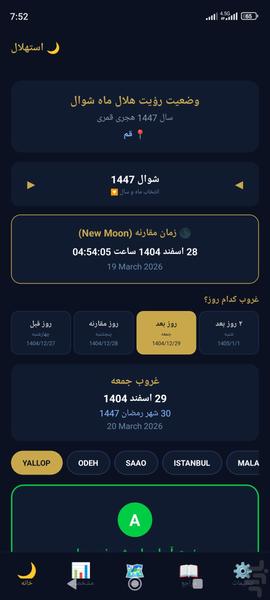
Each criterion provides a clear A–F rating:
A = Easily visible with naked eye
B = Visible under favorable conditions
C = Optical aid needed
D = Telescope only
F = Not visible
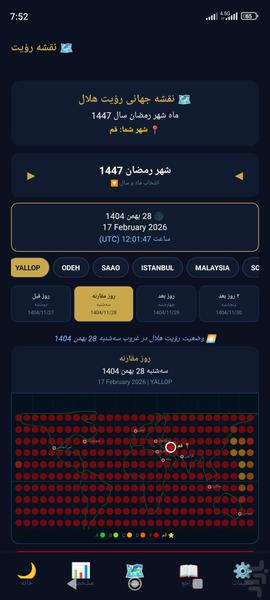
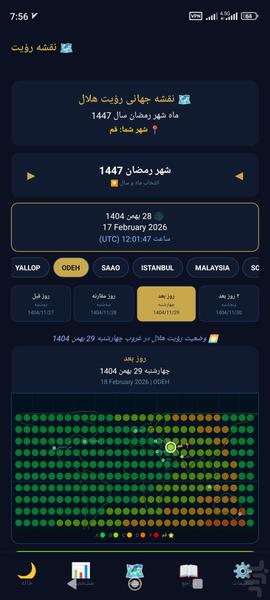
🗺 GLOBAL VISIBILITY MAP
A color-coded world map showing crescent visibility status across the globe. See at a glance where the crescent is visible — from New York to Mecca, London to Jakarta.
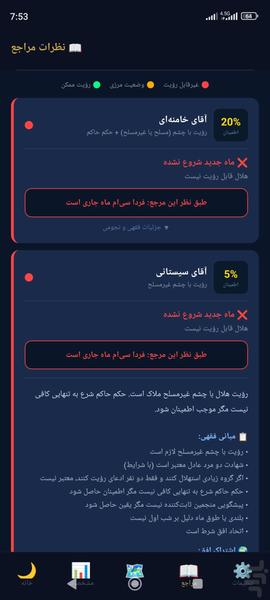
📖 OPINIONS OF 10 SHIA SCHOLARS (MARAJE)
Unique feature: visibility assessment based on the jurisprudential (fiqh) principles of 10 prominent Shia scholars, including:
Ayatollah Khamenei, Ayatollah Sistani, Ayatollah Vahid Khorasani, Ayatollah Shobeiri Zanjani, Ayatollah Makarem Shirazi, Ayatollah Nouri Hamedani, Ayatollah Safi Golpaygani, Ayatollah Sobhani, Ayatollah Fayyad, and Ayatollah Mousavi Ardabili.
Each scholar has distinct rulings on naked-eye vs. telescope sighting, the religious ruler's decree, and horizon-sharing requirements. This app combines their jurisprudential criteria with real astronomical data.
🔭 DETAILED ASTRONOMICAL DATA
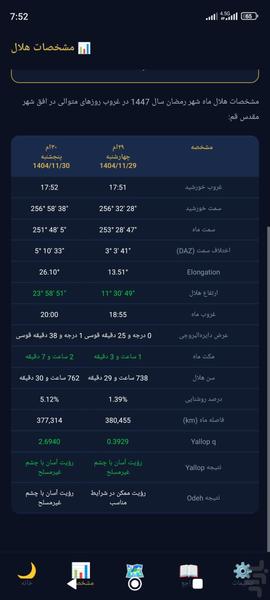
• Precise conjunction (New Moon) time
• Moon altitude at sunset
• Moon age (hours since conjunction)
• Lag time (moonset minus sunset)
• Topocentric elongation
• Illumination percentage
• Crescent width
• Moon distance from Earth
• Ecliptic latitude
• Yallop q-value
• Danjon limit check
• And many more parameters
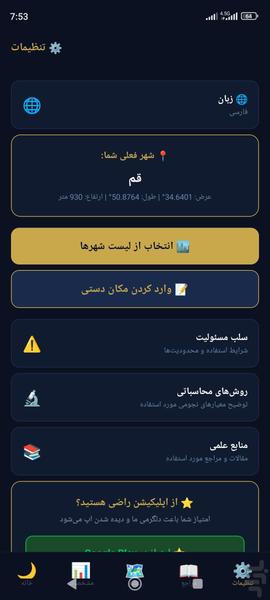
🏙 40+ CITIES WORLDWIDE
Pre-configured cities including:
🇮🇷 Iran: Qom, Tehran, Mashhad, Isfahan, Shiraz, Tabriz
🇮🇶 Iraq: Najaf, Karbala, Baghdad
🇸🇦 Saudi Arabia: Mecca, Medina, Riyadh, Jeddah
🇱🇧 Lebanon: Beirut
🇸🇾 Syria: Damascus
🇪🇬 Egypt: Cairo
🇹🇷 Turkey: Istanbul, Ankara
🇵🇰 Pakistan: Karachi, Islamabad
🇬🇧 UK: London
🇺🇸 USA: New York, Los Angeles, Chicago
🇨🇦 Canada: Toronto
🇦🇺 Australia: Sydney
🇮🇩 Indonesia: Jakarta
🇲🇾 Malaysia: Kuala Lumpur
Plus manual coordinate entry for any location on Earth.
📊 COMPARISON TABLE
Side-by-side comparison of crescent data for the 29th and 30th of each lunar month, making it easy to compare visibility between consecutive days.
🌐 THREE LANGUAGES
Full support for Persian (فارسی), Arabic (العربیة), and English. Language is automatically set based on your device settings, with manual override available in Settings.
📤 SHARE RESULTS
Share detailed visibility reports with friends and family via any messaging app.
⚠️ IMPORTANT DISCLAIMER
This application is solely an astronomical calculation tool. Results are NOT a substitute for actual crescent moon sighting. The definitive determination of Islamic lunar months is based exclusively on actual crescent observation and the rulings of qualified religious scholars. Atmospheric conditions, light pollution, and observer acuity are not factored into these calculations. Always refer to official crescent sighting reports from your religious authority.
🔬 SCIENTIFIC FOUNDATION
Calculation Engine: Astronomy Engine by Don Cross
Planetary Theory: VSOP87
Lunar Theory: ELP/MPP02
Coordinates: Topocentric with Atmospheric Refraction correction
Key References:
• Yallop, B.D. (1997) "A Method for Predicting the First Sighting of the New Crescent Moon" — HM Nautical Almanac Office, Technical Note No. 69
• Odeh, M.Sh. (2004) "New Criterion for Lunar Crescent Visibility" — Experimental Astronomy, Vol. 18, pp. 39-64
• Caldwell, J.A.R. & Laney, C.D. (2001) "First Visibility of the Lunar Crescent" — South African Astronomical Observatory
• Ilyas, M. (1994) "Lunar Crescent Visibility Criterion and Islamic Calendar" — Quarterly Journal of the Royal Astronomical Society
Tags: hilal, crescent moon, Islamic calendar, Hijri calendar, Ramadan, moon sighting, astronomy, lunar visibility, istihla, new moon, Yallop, Odeh, crescent prediction, Islamic months, Shia, Maraje, fiqh
